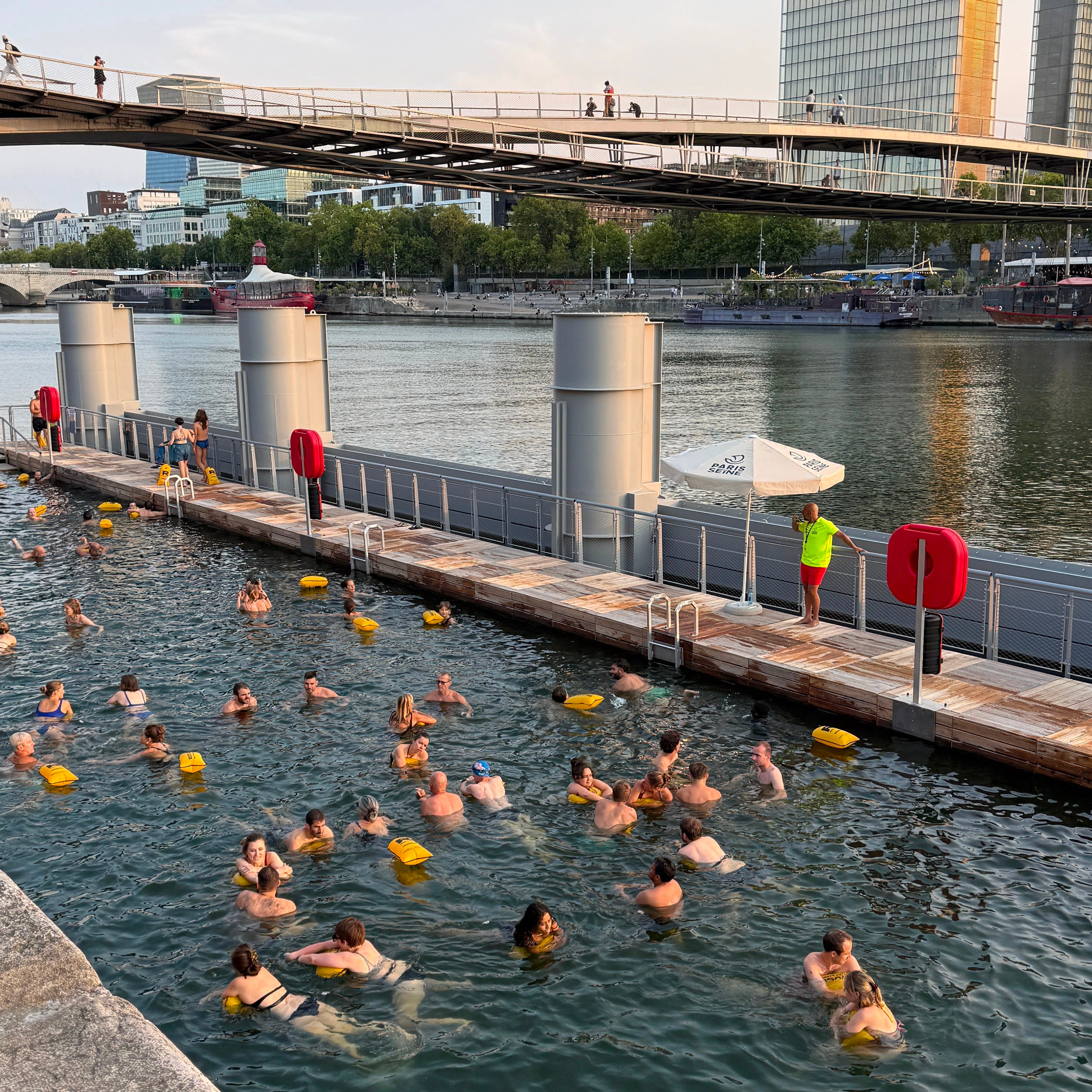
Paris hit 104 degrees Fahrenheit this week.
People are swimming in canals — some 40 of them drowned as they tried to escape the sweltering temperatures, according to the country’s prime minister.
All of this in a place where only about a quarter of households have AC.
NPR had a recap of the heatwave this morning — mentioning all of the data points above, plus the fact that this is the second heatwave to hit Europe this summer, and it’s just June. I was struck, however, not by the (quite harrowing) specifics of this climate disaster but by how much it feels like very many other moments.
NPR’s Rebecca Rosman played a statement from a French news anchor, Patrick Cohen: “We’ll be talking for a long time about the June 2026 heat wave,” Cohen says in the piece, “as a test, a milestone and, perhaps for some, a revelation.”
He compared this heatwave to another deadly one in 2003. “This time,” he says, “it’s impossible to deny the country’s climate is changing before our eyes.”
This time.
I’m going to quibble with the “this time” of it all.
Because we knew back in 2003 that the connections between heat and climate change — driven primarily by burning fossil fuels like coal, oil and gas — were driving crazy temperatures. That heatwave, which is estimated to have killed several tens of thousands of people, actually birthed the field of “climate attribution” science, in which researchers look for human fingerprints on specific weather events.
From a 2019 piece I wrote for CNN:
After that disaster [the 2003 heatwave in Europe], scientists for the first time used “climate attribution” techniques to show that human-induced warming very likely doubled the risk of that event. It’s now possible to see human fingerprints on these catastrophes. Hurricane Harvey in Texas; the 2016 floods in Baton Rouge; Hurricane Maria in Puerto Rico, which killed an estimated 2,975 people, according to an analysis by George Washington University. Each was linked to – or was shown to have been made worse by – global warming.
I understand the news-y desire to talk about the present moment as if it were unprecedented. The events of France are shocking. They’re tragic. They also are part of a longstanding pattern of Earth Amnesia that has been repeating itself for decades.
We news folks love a dose of myopia.
But this time isn’t new.
It’s a product of our inability to ditch an addiction to fossil fuels.
And it’s an addiction we’ve had for many decades now.
Human beings are weird. They love drama. Not all, but a lot! I mean, look around. The news catastrophes, as long as it doesn't kill you, or a family member, it fills some kind of craving. My 86-year-old mom is a drama addict, and she was a really good elementary school teacher for 31 years, so not a cigarette-sucking trailer-trash example. She taught kids about the rainforest.
These things lurk in humans. We are not logical or rational. I have studied the environment most of my life, both passively since a child, and actively in my college studies. Yet even I find myself going, "Whoa, look at those flood waters!"
Without a knowledge of all the micro and macro causes, how we are doing this to ourselves, most humans are just stuck in the drama loop. True Crime, maybe. We don't deserve this Earth.
I’m not sure if this is true or not but it seems that regardless of how loud the scientific community is on this subject it is drowned out by denialism and pseudoscience.
This is the societal equivalent of standing at a craps table yelling “my credit’s good!” while letting the dice loose to cascade across the table. Eventually we crap out. But losing “the bet” here has more significant consequences.